

#18 - Kant's Aesthetics - One Step Back, Two Steps Forward
Conncecting the Fourth Moment to the Transcendental Deduction

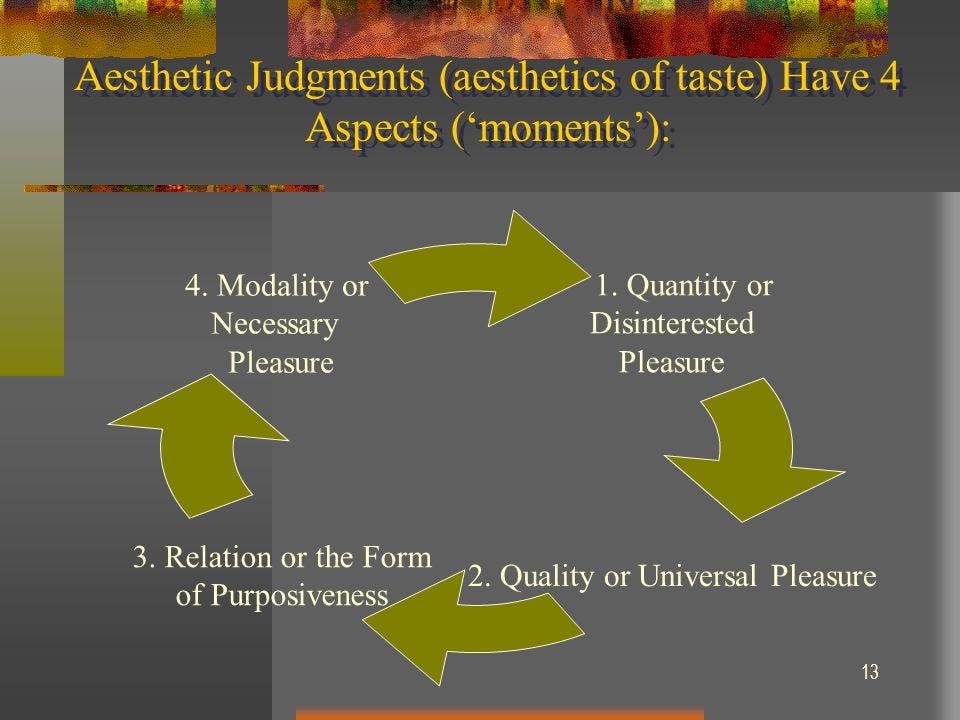
Kant’s exposition of judgments of taste, i.e, judgments of beauty, involve four broad concepts which he refers to as moments—quantity, quality, dynamism, and modality. Each represents some broad concept that makes such a judgment possible. Kant wants to distinguish between common parlance, where we treat beauty as if it were the property of an object, and what Kant believes is happening transcendentally. Kant is stating that beauty is a result of an inner reflection on the operations of our mind triggered by an image that stimulates one of the key mechanisms in that process, the imagination. For Kant, imagination refers to the process whereby we string sensations into coherent images about which we can make a judgement. A dog may be both beautiful and furry, but beauty is not a property in the same way as furriness.
Judgments of beauty will refer to something quantifiable even when it refers to the non quantifiable, e.g., the sublime, judgments of beauty will be qualitatively different from other types of judgments, aesthetic judgments have a purposiveness (movement or dynamism), and each such judgement assumes necessary universal agreement (movement of modality).
The question came up about the term “dynamic” and its application to the moments of beauty. Kant introduces the term in his discussion of the sublime, stating that the first two moments of the sublime, quality and quantity, are mathematical, the third moment, purposiveness, is dynamic, and the fourth moment is modal. This classification parallels Kant's analysis of concepts important to knowledge in the Critique of Pure Reason. There he refers to them as categories, here as moments. Kant want to use the term, “categories,” when we use concepts to make objective judgments and prefers the term, “moments,” when we are using these concepts solely for subjective reflection, not for objective understanding.
(Be aware that for Kant, "taste” refers to a beautiful object, like the Venus de Milo, which we expect will give pleasure to everyone who beholds it; by “agreeable,” Kant means purely one’s own idiosyncratic tastes, e.g. my taste for coffee, which we don't expect everyone to share. Kant is not using the term “taste” in exactly the same way that we use the term today. So for Kant, the terms “judgment of taste,” “aesthetic judgment,” and “judgment of beauty” are synonymous.)
§ 18. What is meant by the modality of a judgment of taste?
Of every representation . . . it is . . . possible that it . . . [can] be combined with a pleasure.
The agreeable produces a pleasure in me. The beautiful has a necessary relation to satisfaction, a special kind of necessity, an exemplary kind, in which everyone is expected to see the object as an example of beauty. The fact that one expects everyone to agree to that example implies a universal rule that can never be produced.
§ 19. The subjective necessity that we ascribe to the judgment of taste is conditioned.
The judgment of taste ascribes assent to everyone. . .
The should is conditioned upon all of us having the same data required for judging. We all agree that the world is round because we all observe the same data. There is a subjective element in objective judgments of fact. Aesthetic judgments share this subjective element. The necessity to agree is subjectively contingent upon the data.
§ 20. The subjective condition of . . . necessity . . . is the idea of a common sense.
If judgments of taste . . . had a determinate objective principle, then someone who made them in accordance with the latter would lay claim to the unconditioned necessity of his judgment.
No one thinks of necessity in cases of sensory taste. If a taste for coffee were the same as the fact of the earth’s shape, anyone disliking coffee would be lacking common sense: 1) in the Kantian sense, as a faculty which all humans possess, 2) and in the way we commonly understand the term, something everyone normally would agree with, and about which only weirdos would disagree.
§ 21. Is there any reason to presuppose a common sense?
Cognitions and judgments must. . . be able to be universally communicated, for otherwise they would have no correspondence with the object . . .
It is because our minds all process knowledge of objects in the same way that we are able to communicate about them. If we all experienced objects differently, then we would truly be living in a subjective reality and have reason to be skeptical about the possibility of objectivity. If experiences can be communicated, then so, too, can the feelings that accompany them.
A subject-object relationship is necessary in order to have knowledge and experience, and knowledge is a result of the synthesis of sensation with concepts. There must be a mental disposition in which this inner relationship is optimal for the animation of these powers of the mind (coherent sensation or imagination and understanding the item being sensed). Feelings let us know when our mind has reached this optimal disposition, and we are able to communicate these feelings to others.
§ 22. The necessity of the universal assent that is thought in a judgment of taste is a subjective necessity, which is represented as objective under the presupposition of a common sense.
[When] we declare something to be beautiful, we allow no one to be of a different opinion. . . which we . . . make our ground not as a private . . but as a common [feeling] .
Now this common sense cannot be grounded on experience for this purpose. Everyone on earth will experience gravity, but the beauty of Michaelangelo’s David should be experienced by everyone that sees the sculpture. Thus the common sense is a merely ideal norm of what is exemplary. In this sense, judgments of taste are similar to other empirical judgments. If everyone looks at the data, we should all agree that climate change real. Unlike factual judgments, however, the only thing we can look at to justify judgments of beauty is the feeling that the object produces in us.
The definition of the beautiful drawn from the fourth moment.
That is beautiful which is cognized without a concept as the object of a necessary satisfaction.
When we are saying that something is beautiful, we are speaking as if we were making an empirical, factual judgment that a certain object will be found to produce pleasure in everyone that observes it.
§ 37. What is really asserted a priori of an object in a judgment of taste?
That the representation of an object is immediately combined with a pleasure can be perceived only internally, and . . . yield a[n] . . . empirical judgment.
The pleasure we feel when beholding a beautiful tree is not a result of the concept of a tree but is immediately connected with the sensation of a particular tree, a sensation of which we are consciously aware, making our judgment of it empirical.
§ 38. How do we deduce the principles that enable taste?
. . . in a pure judgment of taste the satisfaction in the object is combined with the mere judging of its form . . . it is . . . the subjective purposiveness of that form . . . that we sense as combined with the representation of the object in the mind.
What one feels when seeing a particular tree will vary from person to person but that one feels does not vary, and herein, in that capacity which we all have, to feel and judge that feeling, lies some universal principle.
Remark
This deduction is so easy because it is not necessary for it to justify any objective reality of a concept. . . beauty is not a[n empirical] concept. . . and taste . . . is not [a cognitive] judgment.
Now while any particular judgment about beauty may in some sense be “wrong,” in that it violates the transcendent principles we are examining, that would in no way invalidate the point that there must be some a priori principles underlying the judgment any more than a mistake in calculation would negate the underlying principles of mathematics. Kant is saying that it might be possible, as in math, to make an error when judging whether or not something is beautiful.
§ 39. What are the distinctions between communicating different senses?
If sensation, as the real in perception, is related to cognition, it is called sensory sensation . . .
It may be difficult to communicate the effect that certain sensations have on us to someone with a sensory disability, and even when there is no disability, there's no guarantee that two able people will perceive the same object in the same way. Not everyone will find the same sensations to be agreeable. I like spicy food, many of my family members do not. Kant refers to this kind of pleasure as the pleasure of enjoyment. It is a delight in sensation.
The pleasure in the sublime in nature . . . also lays claim to universal participation, yet already presupposes another feeling, namely that of its supersensible vocation, which, no matter how obscure it might be, has a moral foundation.
But that other human beings will find a satisfaction in the consideration of the brute magnitude of nature is not something that I am justified in presupposing, but I can require even that satisfaction of everyone by means of the moral law is grounded in concepts of reason. It is unclear to me whether Kant saying that the feeling of awe that we have when viewing the sublime is a feeling that one can argue for or whether he is saying that the moral element connected with that feeling can certainly be argued for, whether or not any person feels awed by the representation associated with the ideal.
§ 40. Taste is a kind of sensus communis.
The power of judgment . . . is often called a sense . . . a sense of truth. . . propriety, for justice, etc., although one surely knows . . . that these concepts cannot have their seat in a sense . . .
A representation of these Platonic ideas require an elevation to higher cognitive faculties that we cannot find in experience. The common human understanding is regarded as the least that can be expected from anyone and thus has the unfortunate honor of being endowed with the name of common sense. The word “common” can have the connotation of crude or vulgar.
The following maxims of the common human understanding do not belong here, to be sure, as parts of the critique of taste, but can nevertheless serve to elucidate its fundamental principles.
1. To think for oneself.
2. To think in the position of everyone else.
3. Always to think in accord with oneself.
The first is the maxim of the unprejudiced way of thinking, the second of the broad-minded way, the third that of the consistent way. The first is never passive. The second tends towards prejudice and superstition. Liberation from superstition is called enlightenment.
*One readily sees that while enlightenment is easy in thesi, in hypothesi it is a difficult matter that can only be accomplished slowly. . .
It is superstition above all that deserves to be called a prejudice, since the blindness to which superstition leads is what makes most evident the need to be led by others, hence the need of a passive reason. By suggesting that passive reason has some function, we are also revealing a teleological capacity for a broad-minded way of thinking if one sets oneself apart from the subjective private conditions of the judgment, within which so many others are bracketed. We do this by putting ourselves into the standpoint of others. The third maxim advocates a consistent way of thinking and is the most difficult to achieve. It can only by achieved by careful observance of the first two. One can say that the first is the maxim of the understanding, the second of the power of judgment, the third of reason.
I take up again the thread that has been laid aside through this digression, and say that taste can be called sensus communis with greater justice than can the healthy understanding . . .
It is the aesthetic power of judgment rather than the intellectual, that can truly bear the name of a communal sense. One could even define taste as the faculty for judging that which makes our feeling in a given representation universally communicable without the mediation of a concept.
The aptitude of human beings for communicating their thoughts also requires a relation between the imagination and the understanding in order to associate intuitions with concepts and concepts in turn with intuitions,
Communicating requires relating what we sense to concepts in a way that produces knowledge, but the communication of knowledge is a result of the lawful agreement of the two powers of the mind. Only where the imagination freely arouses the imagination, i.e., when it does so without the need to apply empirical concepts, is the representation communicated, not as a thought, but as the inner feeling of a purposive state of mind.
Taste is thus the faculty for judging a priori the communicability of the feelings that are combined with a given representation (without the mediation of a concept).
If one could assume that the mere universal communicability of one's feeling must in itself already involve an interest for us, then one would be able to explain how it is that the feeling in the judgment of taste is expected of everyone as if it were a duty.
time to be interested in it. Because of this affinity, however, this interest is moral, and he who takes such an interest in the beautiful in nature can do so only insofar as he has already firmly established his interest in the morally good.
It will be said that this explanation of aesthetic judgments in terms of their affinity with moral feeling looks much too studied to be taken as the true interpretation of the cipher by means of which nature figuratively speaks to us in its beautiful forms.
But, first, this immediate interest in the beautiful in nature is not actually common, but belongs only to those whose thinking is either already trained to the good or especially receptive to such training. To the objective lawful ground of morality is added the admiration of nature, which in its beautiful products shows itself as art, not merely by chance, but as it were intentionally, in accordance with a lawful arrangement and as purposiveness without an end, which latter, since we never encounter it externally, we naturally seek within ourselves. This connects Kant's aesthetic theory to his theory of teleology, and one here also sees the link with continental philosophy and the nineteenth-century romantic movement.
That the satisfaction in beautiful art in the pure judgment of taste is not combined with an immediate interest in the same way as that in beautiful nature is also easy to explain.
For the former is either an imitation of nature’s art and has similar effects or else it is an art that is obviously intentionally directed toward our satisfaction, that is, it would be an art that can interest only through its end and never in itself. One will perhaps say that an object of nature only interests us insofar as a moral idea is associated with it, but it is really the qualities that the beautiful and the moral have in common with each other in which we have an immediate interest.
The charms in beautiful nature, which are so frequently encountered as it were melted together with the beautiful form, belong either to the modifications of the light (in the coloring) or of the sound (in tones).
For these are the only sensations which permit not merely sensory feeling but also reflection upon them. Thus the white color of the lily seems to dispose the mind to ideas of innocence, and the song of the bird proclaims joyfulness. But the interest of beauty absolutely requires that it be the beauty of nature, not manmade art.